
Henry Munyaradzi, 1931–1998
Henry Munyaradzi’s background — like his life and work — is deceptively simple yet remarkable. He was born in 1931 in Guruve, in northern Zimbabwe.
His father, a spirit medium, left the family when Henry was very young. His childhood was typical of rural Zimbabwe at the time: herding cattle, hunting with dogs, spears, and bows. He never attended school and spoke very little English throughout his life. As a young man, he worked closely with the land — first as a village blacksmith, then as a carpenter and tobacco grader.
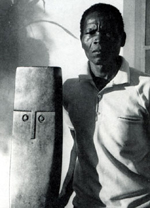 Everything changed in 1967 when, out of work, he encountered the Tengenenge Sculptors’ Community founded by Tom Blomefield. Munyaradzi began sculpting, working alone from the start and developing a powerful, original visual language.
He quickly became one of the leading artists of the community, eventually leaving in 1975 to work independently.
Everything changed in 1967 when, out of work, he encountered the Tengenenge Sculptors’ Community founded by Tom Blomefield. Munyaradzi began sculpting, working alone from the start and developing a powerful, original visual language.
He quickly became one of the leading artists of the community, eventually leaving in 1975 to work independently.
Munyaradzi’s work was included in exhibitions early in his career — his first show at the National Gallery of Zimbabwe was in 1968. Over the decades, he exhibited widely in group and solo shows across the world. His striking linear imagery and distinctive geometric incisions made him internationally celebrated.
The strength of his work lies in its purity of form. Technique and imagery are reduced to their essence, capturing subjects with clarity and simplicity. His confident lines and sculptural geometry have often been compared to the work of Paul Klee. Entirely self-taught, Munyaradzi blended the simplicity of the “primitive” with a refined, stylized sophistication. He deeply respected the stone he carved and often drew inspiration from its natural shape.
Henry Munyaradzi participated in major group exhibitions and held eight solo shows in London, Los Angeles, Berlin, and Harare. His work is represented in the National Gallery of Zimbabwe, Chapungu Sculpture Park, and numerous museums and private collections worldwide.
source: CAMA.org.za photo: “Life in Stone: Zimbabwean Sculpture — Birth of a Contemporary Art Form” (1994), Oliver Sultan