

 |
|||||||
|
______________________________________________________________________________________________________________________
|
|||||||
HOME |
|
| ARTISTS
|
|
| CONTACT |
|
| NEWS
|
|
|
BIO | EXHIBITIONS | AVAILABLE WORK
FRÉDÉRIC BRULY BOUABRÉ, 1923 - 2014
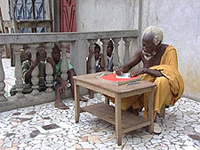
BIO Frédéric
Bruly Bouabré, was born in 1923 in Zéprégüé,
Côte d’Ivoire. From then on Bruly Bouabré tackled every field of knowledge and collected his research in manuscripts about arts and traditions, poetry, tales, religion, esthetics, and philosophy, revealing himself to be an astonishing thinker, poet, encyclopedist, creator. Searching for a way to preserve and transmit the knowledge of the Bété people, as well as the knowledge of the entire world, he invented an alphabet of 448 monosyllabic pictograms to represent phonetic syllables. This endeavor earned Bouabré the legendary reputation of being another Champollion, in reference to the great scholar and linguist Jean-Paul Champollion (1790-1832), who discovered the key to understanding Egyptian hieroglyphs. Bouabré’s alphabet, which can transcribe all human sounds, reflects the essence of his thought: to achieve universality and to unite mankind.
Other projects, such as Readings from Signs Observed in Oranges (1988), serve as visionary records of divination. For Frédéric Bruly Bouabré, his drawings are representation of everything that is revealed or concealed—signs, divine thoughts, dreams, myths, the sciences, traditions—and he views his role as an artist as a redemptive calling. He has stated: “Now that we are recognized as artists, our duty is to organize into a society, and in such a way to create a framework for discussion and exchange among those who acquire and those who create. From that could arise a felicitous world civilisation.” source: Africultures.com; First Run Icarus Films; Contemporary African Art Collection
|
||
|
LINKS
|
|
about
us
| africa
today | artists
| contacts
| painting
|photography
| sculpture
african contemporary - contemporary african art gallery (c) 2017 > All rights reserved | privacy policy |